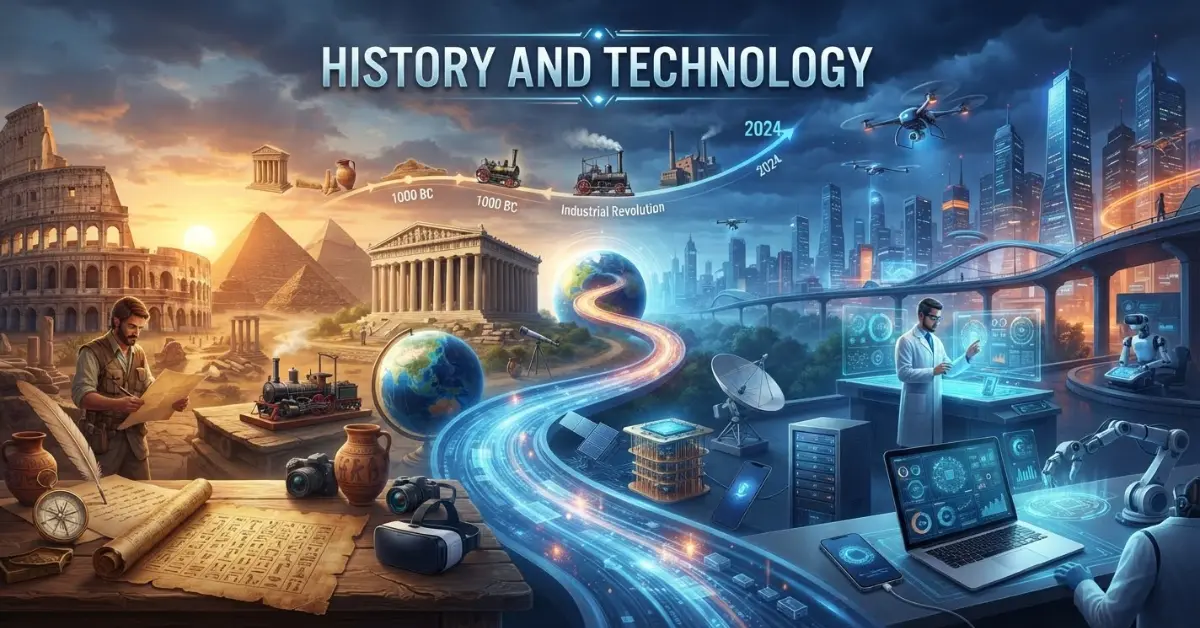
The relationship between History and Technology, Shows how human innovation has shaped societies over time. From the invention of the wheel and the development of early writing systems to the rise of computers, the internet, and artificial intelligence, technology has continuously transformed the way people live, work, and communicate. Understanding History and Technology helps us explore how past inventions influenced modern life and how technological progress continues to shape the future. By studying these developments, we can better understand the connection between human creativity, scientific discovery, and social change.
What Is the History of Technology?
The history of technology is the story of how people created tools, machines, and new ideas to make life easier. It began with simple tools such as stones and developed over time into advanced machines, computers, the internet, and artificial intelligence. Each new invention helped people solve problems, save time, and improve their daily lives. By studying the history of technology, we can understand how past inventions shaped the modern world.
Technology in Ancient Times
Ancient people developed many useful technologies to make farming, building, travel, and daily life easier.
- The Wheel: Helped people move heavy objects and travel more easily.
- Writing: Allowed people to record information, laws, stories, and history.
- Irrigation: Helped farmers bring water to crops and improve farming.
- Metal Tools: Copper, bronze, and iron were used to make stronger tools and weapons.
- Early Ships: Made travel, fishing, and trade across rivers and seas easier.
- Simple Machines: Levers, pulleys, and other tools helped people lift and move heavy objects.
- Building Technology: Ancient people used new methods to build roads, bridges, homes, and large structures.
Ancient technologies created the foundation for many tools and systems used in later periods.
The Industrial Revolution
The Industrial Revolution was a major period when machines and factories changed how people worked, traveled, and made products.
- Steam Power: Steam engines provided power for machines, factories, trains, and ships.
- Factories: Large factories made it possible to produce goods faster and in greater amounts.
- Textile Machines: New machines made spinning and weaving much quicker than hand work.
- Railways: Steam trains made travel and the movement of goods faster.
- Iron Production: Better methods of making iron helped build stronger machines, tools, bridges, and railways.
- Mass Production: Machines allowed products to be made in large quantities at lower costs.
- Changing Work: Many people moved from farms to cities to find jobs in factories.
The Industrial Revolution changed traditional work and created the foundation for modern industry and transportation.
The Development of Computers
The development of computers changed the way people work, learn, communicate, and solve problems.
- Early Calculating Tools: Devices like the abacus helped people perform basic calculations.
- Mechanical Computers: Early machines were designed to perform mathematical calculations automatically.
- Electronic Computers: Electronic computers made calculations much faster and more accurate.
- Smaller Computers: Computers became smaller, cheaper, and easier for people to use.
- Personal Computers: PCs brought computing into homes, schools, and offices.
- Laptops: Portable computers made it possible to work and study from almost anywhere.
- Modern Computers: Today, computers can handle large amounts of information and support many digital activities.
The development of computers turned simple calculating machines into powerful tools that are now an important part of everyday life.
The Internet and Digital Technology
The internet and digital technology have made it easier for people to communicate, find information, work, and share ideas around the world.
- The Internet: Connected computers and devices, allowing people to share information quickly.
- The World Wide Web: Made websites and online information easy for people to access.
- Email: Made sending messages faster than traditional mail.
- Social Media: Helped people connect, share content, and communicate online.
- Online Learning: Gave students access to courses, lessons, and educational resources from home.
- Digital Services: Made shopping, banking, booking, and many other activities possible online.
- Cloud Technology: Allows people to store and access files and information through the internet.
The internet and digital technology have connected people and made many everyday tasks faster and easier.
Positive and Negative Effects of Technology
Technology has made life easier and more connected, but it also brings some challenges that people need to understand.
| Positive Effects | Negative Effects |
| Makes communication faster | Can reduce face to face communication |
| Helps students learn easily | Can cause too much screen time |
| Improves healthcare | Creates privacy and security risks |
| Makes work faster and easier | Some jobs may be replaced by machines |
| Provides quick access to information | False information can spread quickly |
| Makes shopping and banking convenient | Can increase dependence on technology |
| Helps people connect worldwide | Technology can create electronic waste |
Technology offers many benefits, but using it wisely and responsibly can help reduce its negative effects.
What Can We Learn From Technology History?
The history of technology teaches us how human ideas can change the way we live. It shows that many useful inventions began as simple solutions to everyday problems. We can learn how people improved old ideas, shared knowledge, and created better tools over time. It also reminds us that technology can bring both benefits and challenges. By understanding the past, we can use modern technology wisely and make better choices for the future.
Common FAQs about History and Technology
Here are some Faqs of History and Technology:
How did technology affect ancient trade?
Technology made trade easier through better ships, roads, storage methods, and tools. These improvements helped people exchange goods between distant regions.
Why are historical inventions still important today?
Many modern technologies are built on older ideas. Studying these inventions helps us understand where today’s tools and systems came from.
How did technology help people measure time?
People developed sundials, water clocks, mechanical clocks, and later accurate timekeeping devices. These tools helped organize work, travel, and daily activities.
How did technology change farming?
New farming tools and methods helped farmers prepare land, plant crops, and harvest food more efficiently. Better farming technology also supported growing populations.
How did technology influence exploration?
Improved maps, navigation tools, ships, and instruments allowed explorers to travel farther and learn more about different parts of the world.
Why is energy important in the history of technology?
Different energy sources, such as human power, water, wind, steam, electricity, and fuel, allowed machines to become more powerful and useful.
How did technology improve construction?
Better materials, tools, engineering methods, and machines allowed people to build taller, stronger, and more complex structures.
Can old technology become useful again?
Yes. Some older technologies can be reused or improved when they offer simple, affordable, or environmentally friendly solutions to modern problems.
Conclusion
The history and technology is a long journey from simple tools to powerful digital systems. Over time, human creativity has changed the way we live, work, learn, travel, and communicate. Every generation has added new ideas and improved older inventions. By understanding this history, we can better appreciate modern technology and use future innovations in a smart and responsible way.